Authority Is a Feature, Not a Value


Most orgs treat "ownership" as a culture problem. It's not. It's a missing feature - the same way a form with no validation isn't a training issue, it's a spec gap.
Every engineering culture doc I've read says the same thing: "we value ownership." None of them define what ownership does when tested — what happens, mechanically, the moment someone with more seniority or more urgency tries to reopen a decision that was supposedly closed. That's the actual spec. Everything else is a mission statement.
I've now watched the same failure reproduce across enough contexts — different teams, different companies, different people in the room — that I stopped treating it as a one-off and started treating it as a bug class. This post is the writeup: what the bug looks like, how to detect it in your own org in about two minutes, why AI didn't cause it and won't fix it either, and the one implementation detail that actually closes it.
The bug, stated precisely
Symptom: A decision gets made, agreed on, sometimes even documented — and then gets remade later, informally, by whoever has the most seniority, the most urgency, or the most volume in the room at that moment. This isn't rare. It's not one bad actor. It happens because there's no code path that prevents it.
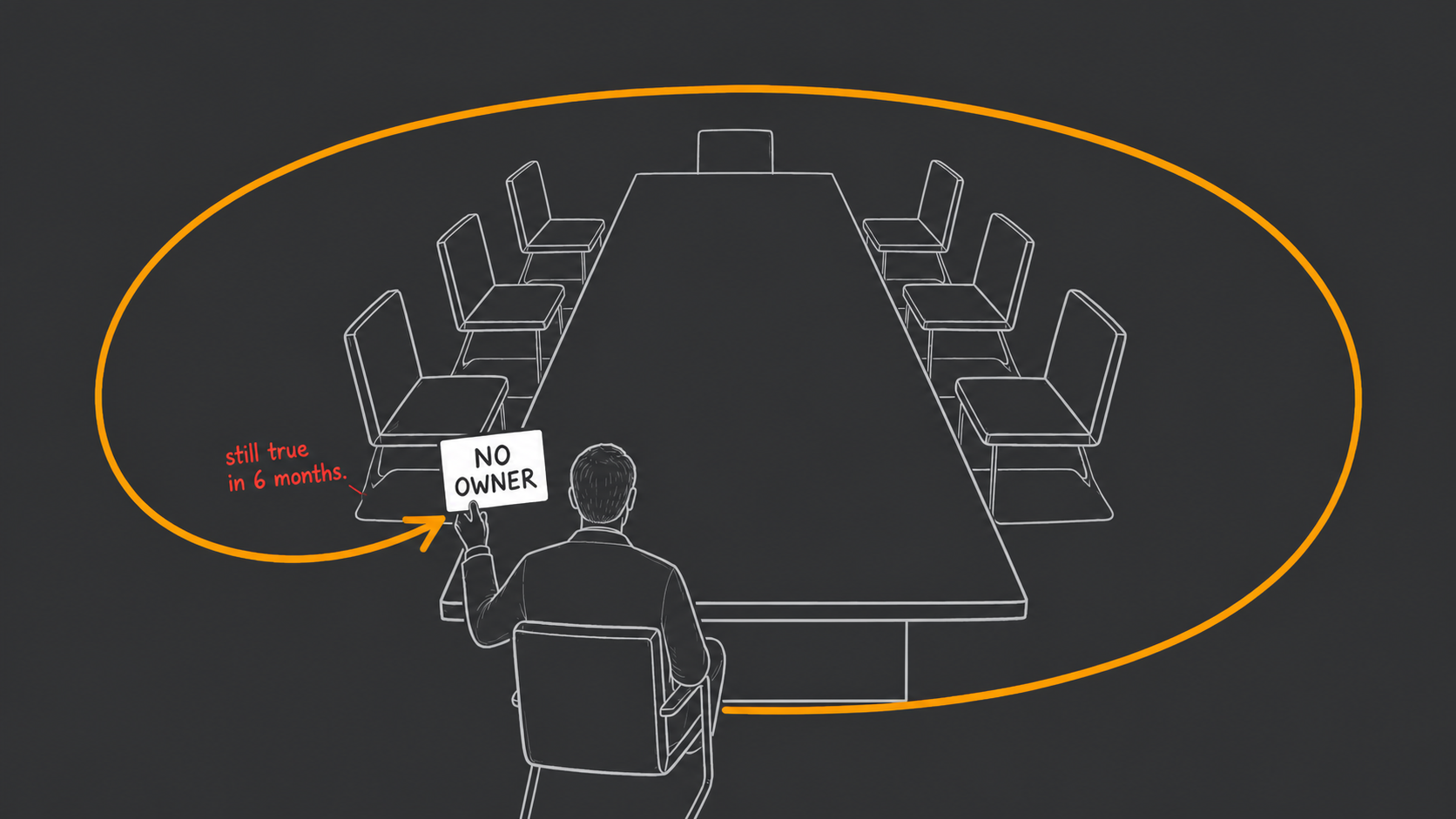
Root cause: Nobody has a checked authority to say no. Not "nobody is responsible" — usually someone is nominally responsible. The bug is that their "no" doesn't survive contact with pressure, because nothing in the system enforces it. It's a permission that exists on paper and gets silently dropped at runtime.
Where it shows up: Scope reopened three days before ship. An approach that was explicitly ruled out getting quietly re-adopted under a deadline. A spec everyone agreed to in writing, overridden by someone who wasn't in the room when it was frozen, with no mechanism to flag the conflict.
If any of that sounds familiar, you don't have a communication problem. You have an unenforced invariant, and it's worth treating it exactly that clinically.
The two-minute test
Pick the last decision in your org that got reopened after it was supposedly final. Ask one question: who could have said no, and had that no actually hold?
- If the answer is a name, and that name's "no" would have been final regardless of who pushed back — you don't have this bug. Good, skip the rest of this post.
- If the answer is "it depends who was in the room" or "whoever had the most context that week" — you have it. Keep reading.
- If you had to think for more than a few seconds to even name a candidate — you have it badly, and it's probably not the first time.
This test works on any team, in any company, in any industry that ships things on a deadline. I'm not naming a specific org here on purpose — not because the pattern is rare, but because it isn't. I've seen it enough times, in enough different rooms, that naming one instance would make it look like an isolated incident instead of what it actually is: a structural default, not an exception.
Where "AI is the problem" gets the diagnosis wrong
The convenient explanation right now is that AI-assisted development broke something that used to work — teams ship faster, so mistakes compound faster, therefore AI is degrading quality. I don't think that's wrong exactly. I think it's incomplete in a way that matters.
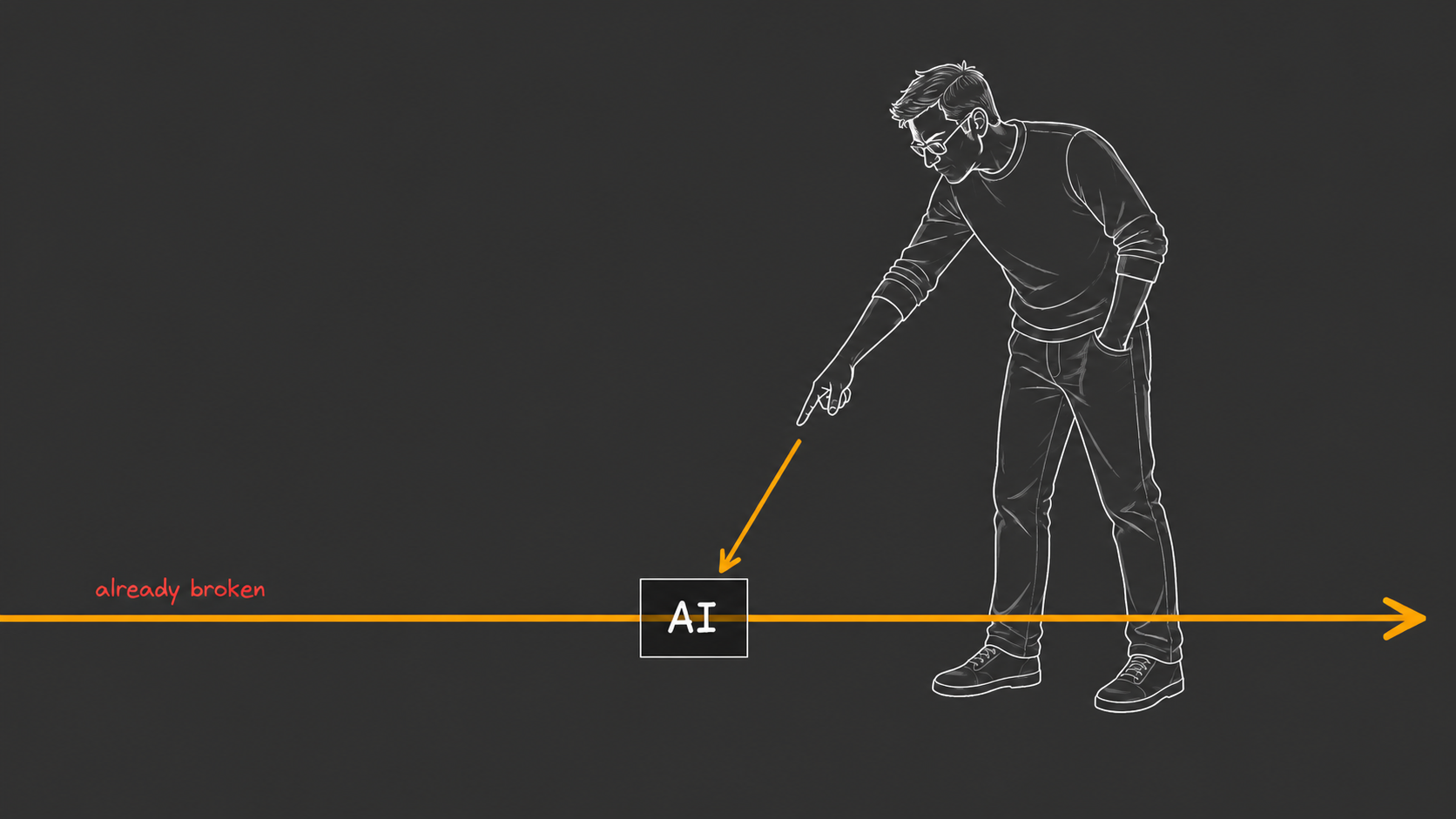
AI didn't introduce the unenforced-authority bug. Every instance I've traced predates any AI tooling being involved at all — these are decision-rights failures, not code-generation failures. What AI changed is the feedback loop's latency. A bad decision used to take two or three weeks to become a visible production problem, which gave an org time to catch it in review, in QA, in a standup where someone finally asked the obvious question. That latency was covering for the missing check. Compress it — and AI-assisted shipping genuinely does compress it, sometimes to hours — and the org discovers it never had the check in the first place, because there was never enough time pressure before to force the discovery.
AI is not here to fix this, and it's not fair to blame it for causing it either. It's an accelerant on whatever was already true. If your org had the authority check in place, AI just means you validate decisions faster. If it didn't, AI means you now find out in production instead of in a retro three weeks later. Same bug, same fix required, wildly different time-to-detection — that's the whole effect, and it's worth being precise about it instead of using AI as a scapegoat for something that was already broken.
The distinction that actually matters: process vs. authority
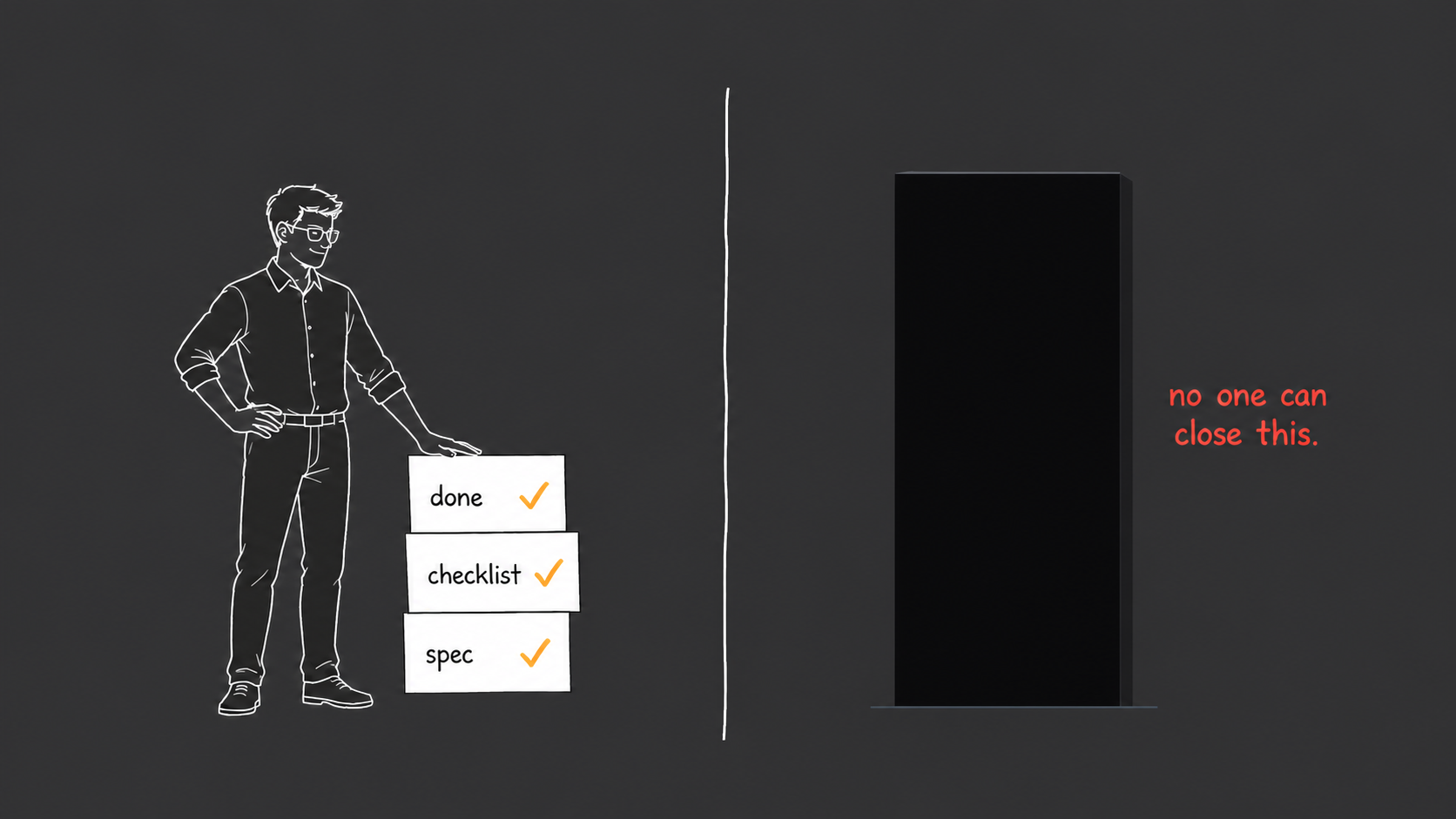
The standard advice at this point is "write better specs, add a checklist, define what 'done' means." That's real advice and it's not wrong — but it's fixing a different bug than the one described above, and conflating the two is why so much process work doesn't actually stop this from recurring.
Process failure: nobody wrote down what "done" means, so two people reasonably disagree about scope. The fix is documentation.
Authority failure: the documentation exists, everyone agreed to it, someone signed off — and it still got overridden later because nobody had a checked, enforceable "no." The fix is not documentation. You can have a perfect spec and zero authority, and the perfect spec will not save you, because nothing stops someone from stepping around it.
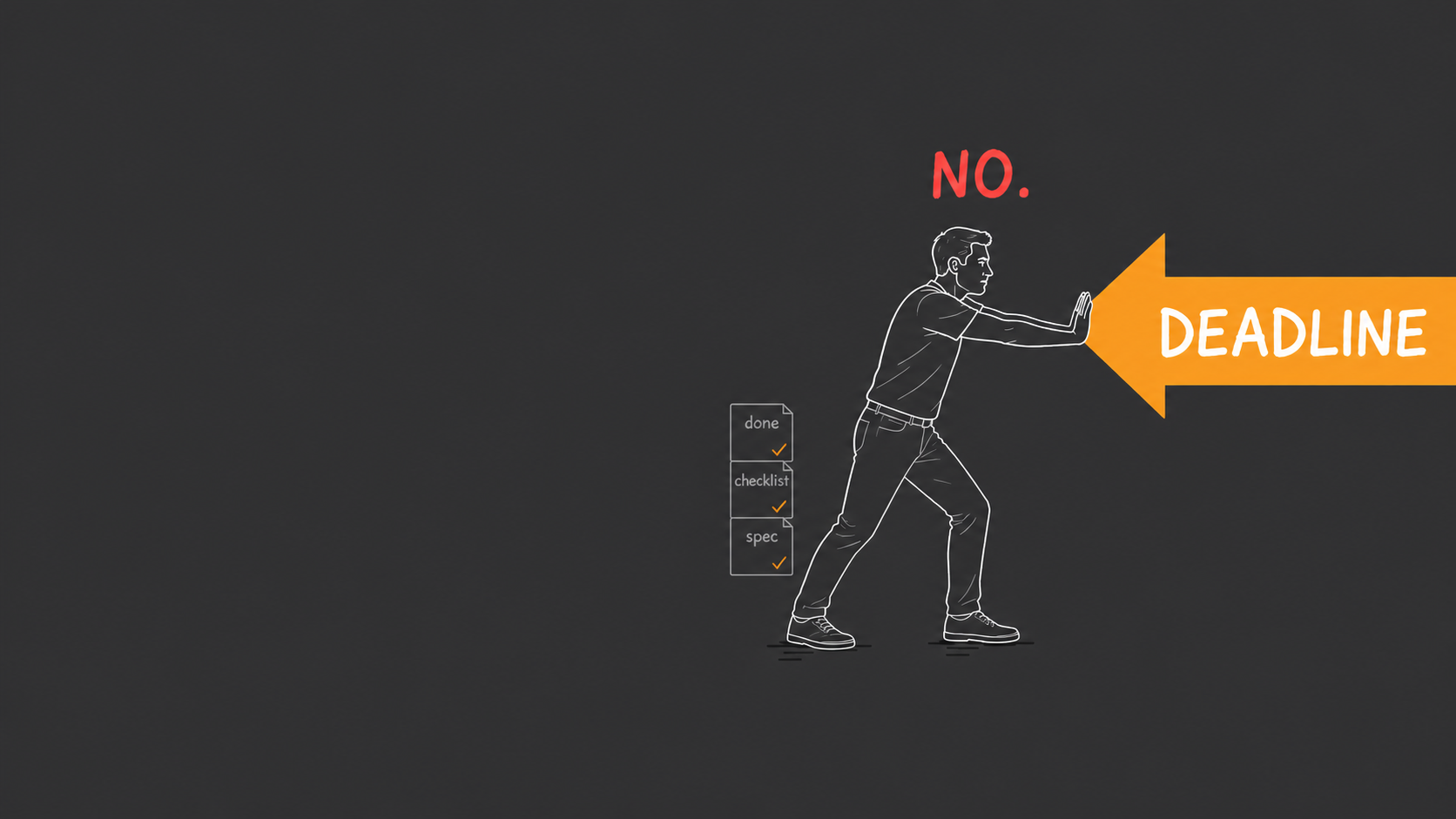
These require different fixes, and most orgs only ever build the first one. A checklist doesn't stop a scope reopen three days before ship. Only a person whose "no" is structurally final does that — and if that person doesn't exist, or exists on paper but gets overridden the first time it's inconvenient, more documentation just gives you a more detailed record of the same failure happening again.
The fix: make "no" a checked operation, not an honor system
Here's the implementation detail, stated as precisely as I can:
Every decision that can ship gets exactly one name attached who can say no — and that "no" has to be enforced the same way a compiler enforces a type, not requested the way you'd ask someone nicely. Concretely, that means: the person exists, is named before work starts (not assigned after something goes wrong), and their "no" doesn't require them to win an argument in the moment — it's simply final, and reopening it is a distinct, visible action that requires going back to them, not a thing that happens by attrition in a Slack thread at 11pm three days before release.
This isn't a call for more hierarchy or slower shipping. A single named owner with real authority can move fast — faster, usually, because decisions stop getting relitigated every time someone new joins the conversation. The goal isn't friction. It's making sure a "no" behaves like an invariant instead of a suggestion.
What to actually do with this on a new working day.
If the two-minute test above said you have this bug, here's the smallest concrete action, not a culture initiative:
- Pick one active project. Write down, in one sentence, who can currently override a "final" decision on it, and under what circumstances. If you can't write that sentence, that's your finding — bring it to your next planning conversation as a specific, nameable gap, not a vague "we should improve ownership."
- For the next decision you make, name the owner before the work starts, in writing, visible to everyone who'll later be tempted to reopen it.
- The next time someone tries to reopen a closed decision under deadline pressure, watch what actually happens. If it reopens anyway, you've just watched the bug reproduce live, with a timestamp — which is a far more useful artifact for a retro than another round of "let's improve communication."
That's the whole ROI of this post: not a feeling that this resonates, but one sentence written down about your own team by the time you're done reading it. If you can't write that sentence yet, that's not a failure — that's the actual first finding, and it's more useful than the feeling of agreement.